Abstract
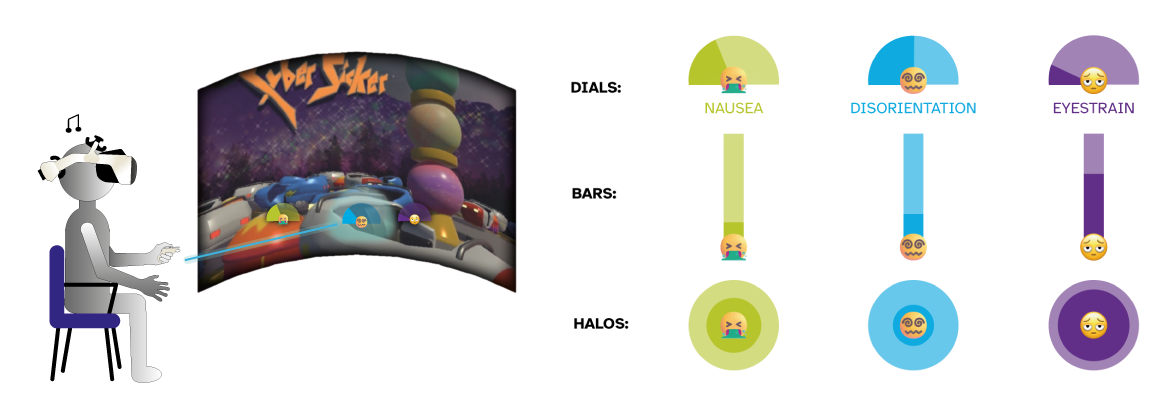
Precise measurements of sickness symptoms induced during a virtual reality (VR) experience are essential for evaluating VR systems and developing designs oriented toward usability, safety and user acceptance. However, VR sickness assessment typically relies either on discrete self-report questionnaires (which lack temporal resolution, interrupt the experience, thus reducing immersion, and provide coarse snapshots of symptom evolution) or on objective signals obtained with biosensors, which typically require extensive postprocessing and interpretation. To address these shortcomings, we propose a continuous interface for real-time self-reporting of VR sickness, designed following a human-centered methodology. We design and evaluate three interface prototypes that allow users to report symptom intensity while remaining fully immersed in the virtual scene. Our findings demonstrate that users significantly prefer the continuous nature of our interfaces over the discrete Likert Scales of traditional questionnaires, identifying them as a more intuitive and less cognitively demanding alternative. In addition, the study allows us to identify the most suitable design according to user-centered criteria. Our contribution is an empirically evaluated continuous interface for real-time VR sickness assessment.
Resources
Interface (GitHub):
Repository
Video:
Video link
BibTeX
@inproceedings{10.1145/3772363.3798515,
          author = {Plaza, Maria and Real, Carmen and Serrano, Ana and Gutierrez, Diego},
          title = {Design and Evaluation of a Continuous Interface for Real-time Self-reporting of VR Sickness},
          year = {2026},
          isbn = {9798400722813},
          publisher = {Association for Computing Machinery},
          address = {New York, NY, USA},
          url = {https://doi.org/10.1145/3772363.3798515},
          doi = {10.1145/3772363.3798515},
          booktitle = {Proceedings of the Extended Abstracts of the 2026 CHI Conference on Human Factors in Computing Systems},
          articleno = {207},
          numpages = {7},
          series = {CHI EA '26}
      }
Acknowledgements
This work was supported by the Government of Aragon’s Departamento de Educación, Ciencia y Universidades through the project HUMAN-VR: Development of a Computational Model for Virtual Reality Perception ($PROY_T25_24$); by grant PID2022-141539NB-I00, funded by MICIU/AEI/10.13039/501100011033 and by ERDF, EU; and funded by the European Union (ERC grant number 101220555, PROXIE). Views and opinions expressed are however those of the author(s) only and do not necessarily reflect those of the European Union or the European Research Council Executive Agency. Neither the European Union nor the granting authority can be held responsible for them.