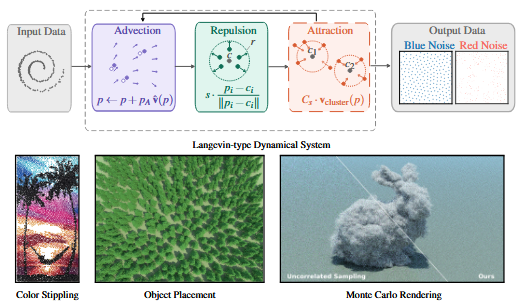
We present a dynamical system for spectral noise point distribution synthesis. Starting from an arbitrary input such as an Archimedean spiral, phasor vector field advection displaces particles along smooth spatially-varying directions, inter-particle repulsion enforces local uniformity, and an optional attraction term enables particle clustering; together forming a Langevin-type dynamical system that produces blue, pink, or red noise within a single pipeline. We showcase the framework across three specific graphics applications: color stippling, object placement, and Monte Carlo rendering.
Abstract
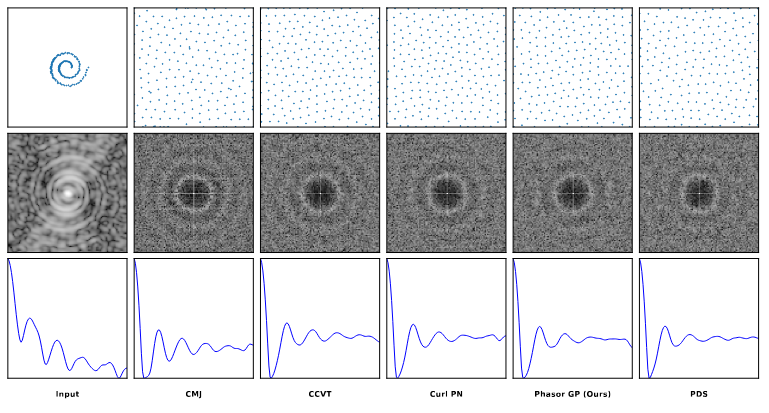
Noise point distributions with specific spectral characteristics, from the perceptually uniform spacing of blue noise to the natural clustering of pink and red noise and the cellular regularity of Voronoi distributions, are fundamental to a wide range of graphics applications, including rendering, stippling, texture synthesis, and procedural generation. We present a unified particle dynamics framework for spectral noise point distribution synthesis, capable of transforming arbitrary irregular input distributions into blue, pink, and red noise patterns within a single simulation pipeline. Our framework combines phasor vector field advection with an inter-particle repulsion step, interpreted as a Langevin-type dynamical system in which the phasor field drives global particle motion while repulsion enforces local spatial uniformity. By introducing an attraction term, the same framework generates pink and red noise through hierarchical spatial organization, providing direct control over the spectral characteristics of the output distribution. We evaluate our method against curl-noise jittering, Lloyd-based methods, and correlated multi-jittered sampling across multiple metrics including anisotropy, discrepancy, spacing, coefficient of variation, and execution time, demonstrating consistent advantages in distribution quality at comparable computational cost. We showcase the framework across three practical graphics applications: color stippling, object placement, and Monte Carlo rendering.
Presentation (EGSR 2026)
Approach
Our framework transforms arbitrary input point distributions into controlled spectral noise patterns through a Langevin-type dynamical system combining three components:
Phasor Vector Field Advection. At each simulation step, points are advected along a smooth unit-length vector field derived from a spatially varying phase function. Unlike curl-noise jittering, phasor-based advection produces continuously evolving directions without discontinuities or aliasing, and its spatial structure can be precisely controlled through a compact phase function parametrized via polynomial or Gaussian radial basis functions.
Inter-Particle Repulsion. After each advection step, a repulsion term displaces each point away from the centroid of its neighbors within a fixed radius. This acts as a dissipative force that enforces local spatial uniformity, driving the system toward a stable blue-noise steady state regardless of the input distribution.
Optional Attraction. By introducing a cluster attraction term into the same pipeline, the framework naturally extends to pink and red noise through hierarchical spatial organization. Increasing the attraction strength while reducing repulsion drives particles toward dominant cluster centers, producing progressively stronger large-scale grouping with radial power spectra following 1/f and 1/f² decay respectively.
Results Gallery
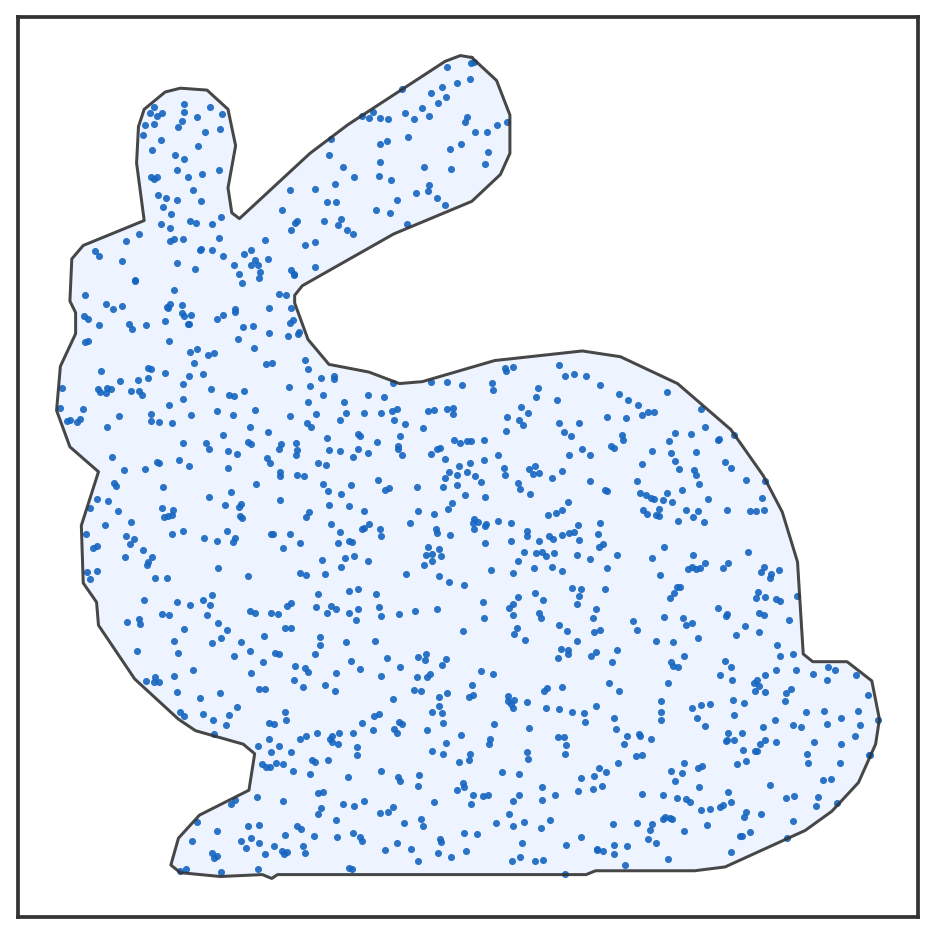
Supplemental video showcasing the progressive transformation of input point distributions into blue and red noise patterns using our particle dynamics simulation, including 2D and 3D experiments in both regular and mesh-constrained boundary domains.
 |
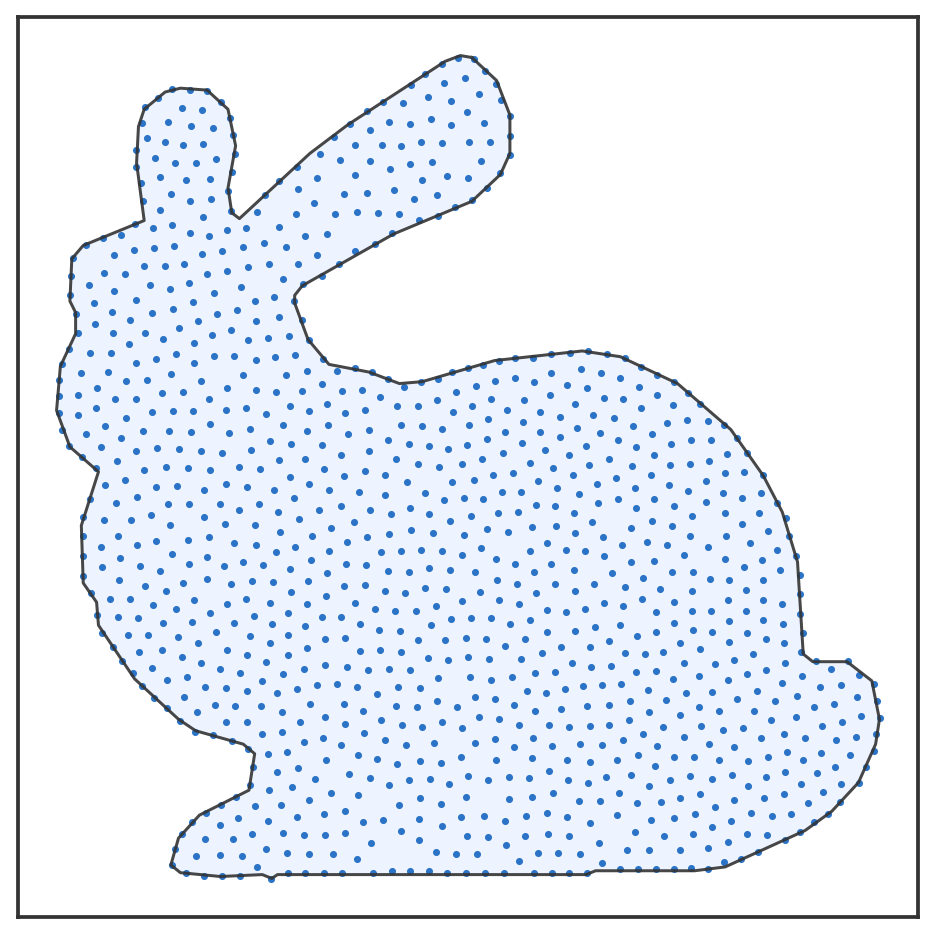 |
| (a) Input: random placement | (b) Output: blue noise distribution |
Resources
Presentation (Slides):
PPTX [EGSR 2026]
Supplemental Video:
YouTube link
Code (GitHub):
Repository
BibTeX
@inproceedings{venu2026_dynamicalsystem,
        booktitle = {Eurographics Symposium on Rendering},
        editor = {Gkioulekas, Ioannis and Jarabo, Adrian},
        title = {{A Dynamical System for Spectral Noise Synthesis}},
        author = {Venu, Bojja and Padr{\'o}n Griffe, Juan Ra{\'u}l},
        year = {2026},
        publisher = {The Eurographics Association},
        ISSN = {1727-3463},
        ISBN = {78-3-03868-320-9},
        DOI = {10.2312/sr.20261006}
        }
Acknowledgements
The authors thank Raúl Padrón and Beulah Griffe for their generous support in funding the conference attendance. We would also like to thank the anonymous reviewers for their valuable feedback and constructive comments, which helped improve the quality of this work.