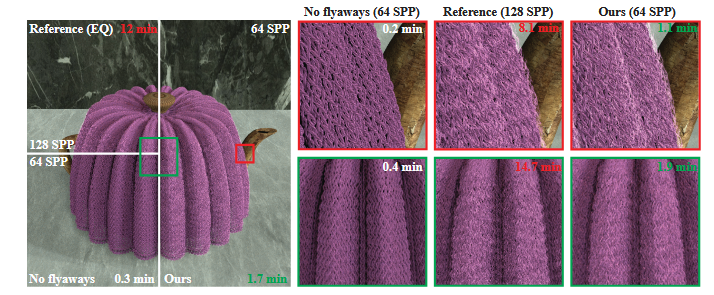
We propose an appearance model for fabric flyaways using 3D Gaussian primitives, with adaptive multi-scale merging of Gaussian mixtures based on pixel footprint. The example shows a fuzzy knitted teapot, illustrating the visual impact of flyaways that are typically neglected in prior work. In far-view, the flyaways create a faint bright silhouette, known as the sheen effect and make the overall appearance less uniform, akin to real-world fabrics. Our method closely matches a reference rendered with explicit curve geometry, while achieving up to 7.4 times faster performance on average across scales and avoiding expensive precomputation and storage costs by using a single tile-able patch of flyaways represented as Gaussians.
Abstract
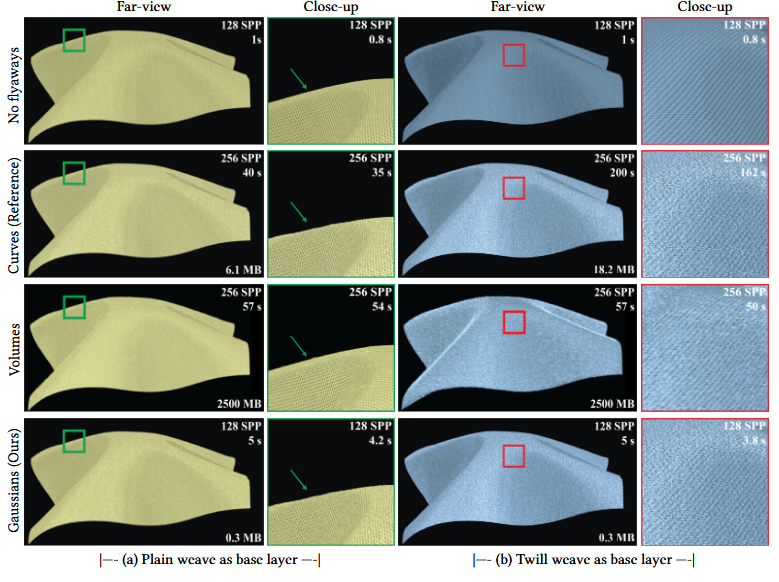
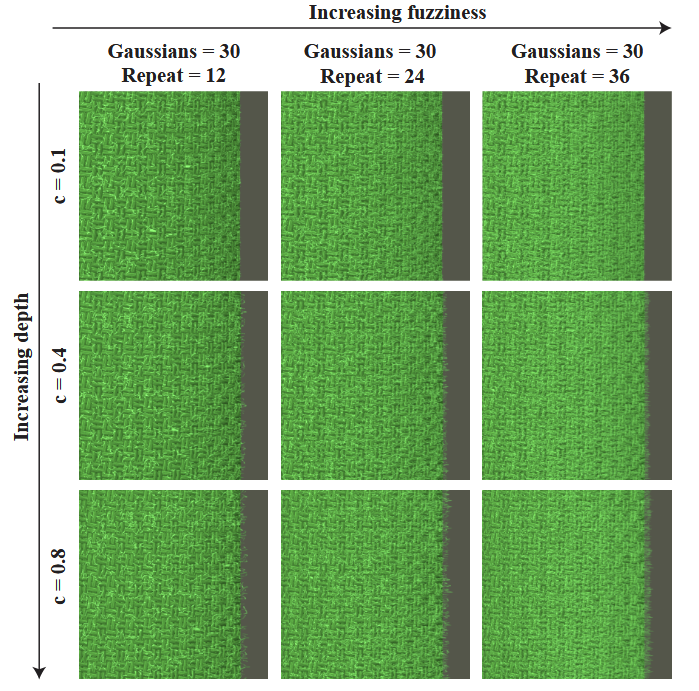
Real-world fabrics exhibit imperfections arising from irregularities in yarn formation, fabric stitching, and everyday wear. These imperfections cause fine fibers to protrude from the fabric surface, producing a characteristic “fuzzy” appearance commonly referred to as flyaways. State-of-the-art approaches model flyaways as explicit curves or a volumetric medium layered on top of the base fabric. However, rendering such representations is computationally expensive and challenging. In this paper, we introduce a multi-scale model that represents flyaways using Gaussians stored in a tilable 3D texture. Modeling flyaways as Gaussians enables efficient aggregation based on the texture footprint: individual fibers are resolved in close-up views, while distant views naturally blend into a soft, hazy silhouette. Our approach integrates seamlessly with existing surface-based or curve-based fabric models that define the base layer. Unlike methods that generate thousands of explicit curve primitives—leading to complex bounding volume hierarchies and high samples-per-pixel requirements to reduce variance—our multi-scale formulation leverages the texture footprint to adaptively determine the number of Gaussians needed. As a result, our method achieves up to 7 to 40 times faster rendering while reducing storage requirements by up to five orders of magnitude compared to volumetric representations , and by over two orders of magnitude compared to explicit curve-based models, all while providing greater artistic and procedural control over the perceived fuzziness of fabrics.
Approach
Our method represents fabric flyaways as a tileable patch of 3D Gaussian primitives, combining three components to make individual fibers efficient to render at any distance:
Gaussian Fiber Representation. Each flyaway curve is discretized into points with a rotation-minimizing frame for a stable local normal. Every consecutive pair of points collapses in closed form into one anisotropic 3D Gaussian, oriented along the segment and scaled to the fiber's radius — no fitting or learning required. An N-point curve becomes N−1 Gaussians whose normal maps closely match the explicit curve geometry they replace, at a fraction of the storage.
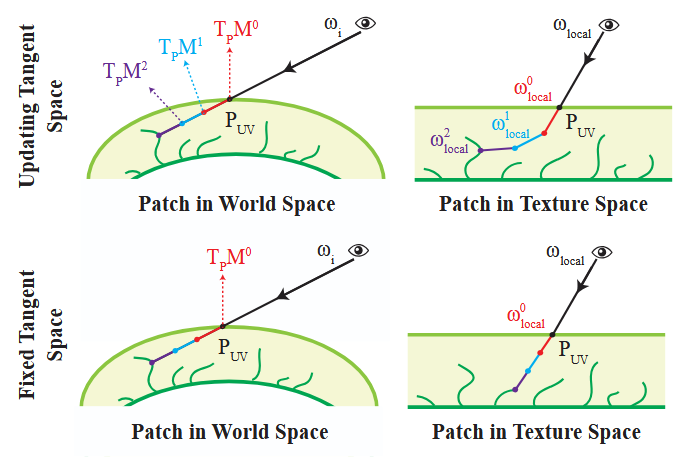
Curvature-Aware Ray Marching. Because the Gaussians live in a repeating tileable texture rather than on explicit displaced geometry, we derive local surface curvature at runtime from the Weingarten map and update the ray's tangent frame at every marching step. The ray continuously bends to follow the base cloth; when it bends far enough to miss the surface, that is registered as a silhouette update — softening the fabric's outline without any precomputed curvature or normal maps.
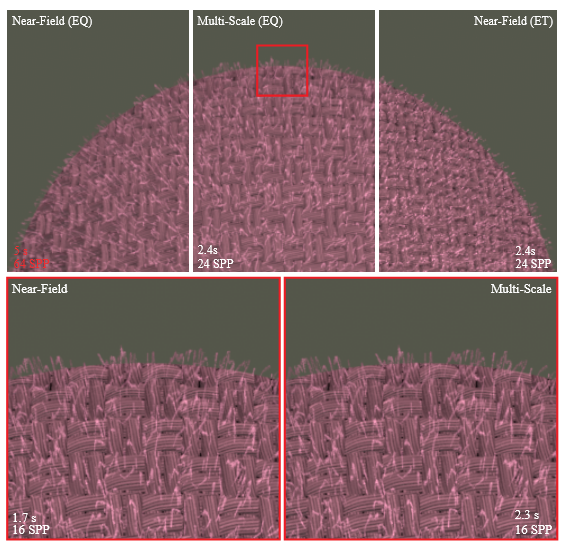
Multi-Scale Merging. As the camera moves away and the pixel footprint grows, Gaussians are merged bottom-up — averaging positions, averaging orientations as quaternions, and taking the tightest enclosing scale across the group — avoiding the variance explosion that classical moment-matching produces for sparse, non-overlapping fibers. Repeating this via k-means clustering builds a mip-map-style pyramid, from one Gaussian per fiber segment down to a single Gaussian for an entire patch.
Results Gallery
Supplemental video showcasing side by side comparison of a knitted teapot and a mannequin dress without and with flyaways, zoom-in and zoom-out revealing strong sheen in the silhouette and relighting by a rotating light. In addition, the video shows the capabilities of the curvature-aware displacement mapping for several height maps.
Resources
Presentation (Slides): Slides
Code (GitHub):
Repository
BibTeX
        @inproceedings{khattar2026flyaways,
          author = {Khattar, Apoorv and Padr\'{o}n-Griffe, Juan Ra\'{u}l and Yan, Ling-Qi and Montazeri, Zahra},
          title = {{Curvature-Aware Multi-Scale Gaussian Appearance Model for Fabric Flyaways}},
          year      = {2026},
          isbn      = {979-8-4007-2842-6},
          publisher = {Association for Computing Machinery},
          address   = {New York, NY, USA},
          url       = {https://doi.org/10.1145/3829340.3842342},
          doi       = {10.1145/3829340.3842342},
          booktitle = {SIGGRAPH Asia 2026 Conference Papers},
          numpages  = {11},
          location  = {Kuala Lumpur, Malaysia},
          series    = {SA '26}
        }
Acknowledgements
We would like to thank the anonymous reviewers for their valuable feedback and constructive comments. This research was partially funded by the University of Manchester Dean’s Doctoral Scholarship Award.