Abstract
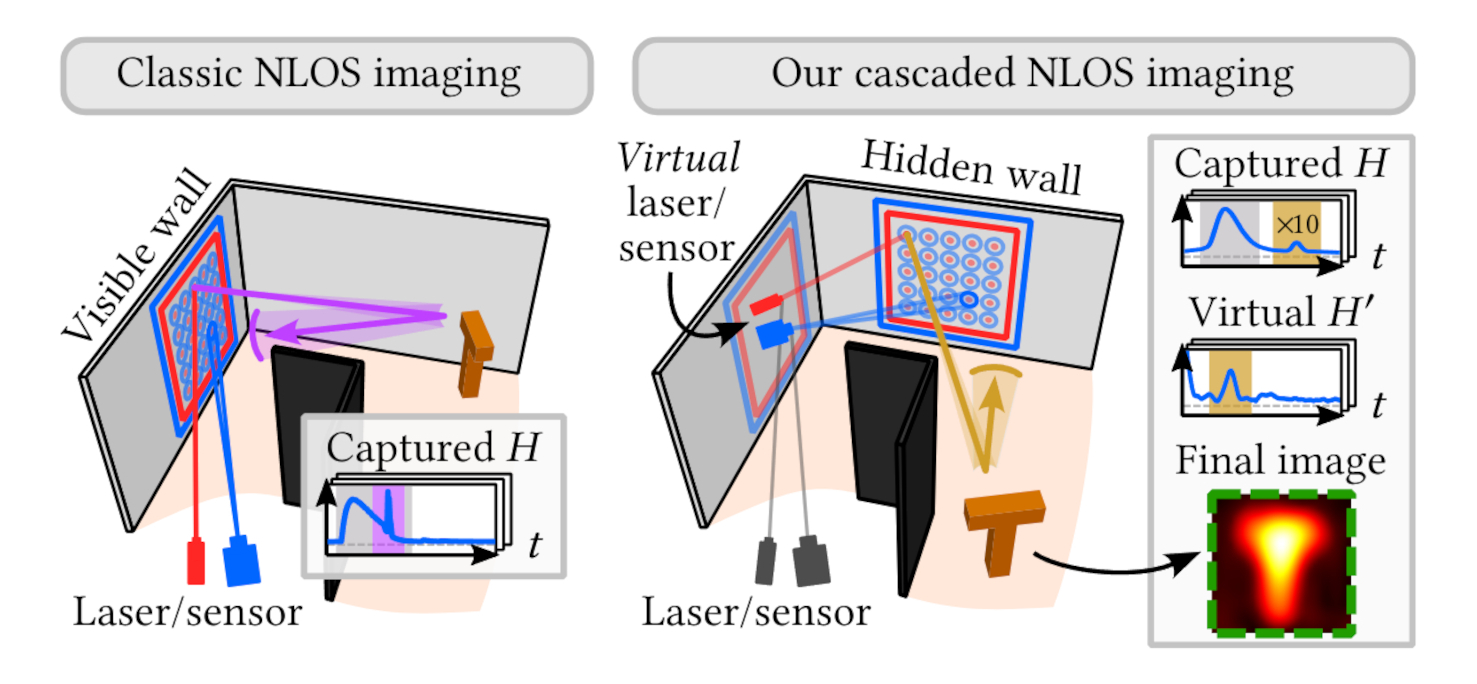
Time-of-flight non-line-of-sight (NLOS) imaging recovers information from hidden objects by analyzing the time of flight of indirect photons scattered on a visible (relay) wall. Most methods make the simplifying assumption that photons travel exclusively three-bounce paths, thus ignoring other useful information encoded in higher-order photons (with, e.g., four- or five-bounce paths). We present a novel cascaded NLOS imaging approach that leverages higher-order information and allows imaging a broader range of single- and multi-corner scenarios. We combine ultra-fast laser scanning with recent time-gated 2D sensor arrays to capture the scene's impulse response on a visible relay wall. From the captured impulse response, our method computes an analogous virtual impulse response at any other hidden wall. This effectively allows us to concatenate a second, virtual NLOS imaging system that leverages higher-order illumination. We validate our cascaded imaging method both in simulation and with a real prototype, demonstrating NLOS imaging with fourth- and fifth-bounce illumination of objects in challenging orientations and hidden around two corners. We also analyze how wave-based NLOS imaging interacts with rough hidden walls, which explains and helps overcome existing visibility limitations. We further illustrate how to image hidden objects from different perspectives, thus observing previously unseen features, by relying on multiple hidden walls.
Paper
Paper:
arxiv
Supplemental Material: Coming soon
Resources
Dataset: Coming soon
Code (GitHub):
Repository
BibTeX
@article{Royo2026Cascaded,
    author    = {Royo, Diego and Pe\~{n}a, Mar\'{i}a and Peterson, Forrest B. and Velten, Andreas and Marco, Julio and Gutierrez, Diego},
    title     = {Cascaded Non-Line-of-Sight Imaging},
    journal   = {ACM Transactions on Graphics},
    volume    = {45},
    number    = {6},
    articleno = {205},
    numpages  = {12},
    year      = {2026},
    doi       = {10.1145/3842503},
}
Acknowledgements
This work has been supported by grants PID2022-141539NB-I00 and PID2025-169453NB-I00, funded by MICIU/AEI/10.13039/501100011033 and by ERDF, EU; and by grant FA9550-26-1-B169, funded by the Air Force Office of Scientific Research. María Peña was supported by the FPU23/03646 predoctoral grant and Diego Royo was supported by the Government of Aragon CUS/803/2021 predoctoral grant. This material is partially based upon work supported by DE-NA0004196 and through the Enabling Technologies & Innovation Graduate Fellowship, funded by the Department of Energy / National Nuclear Security Administration. The authors would like to thank Talha Sultan and the members of the Graphics and Imaging Lab for useful discussions.