Abstract
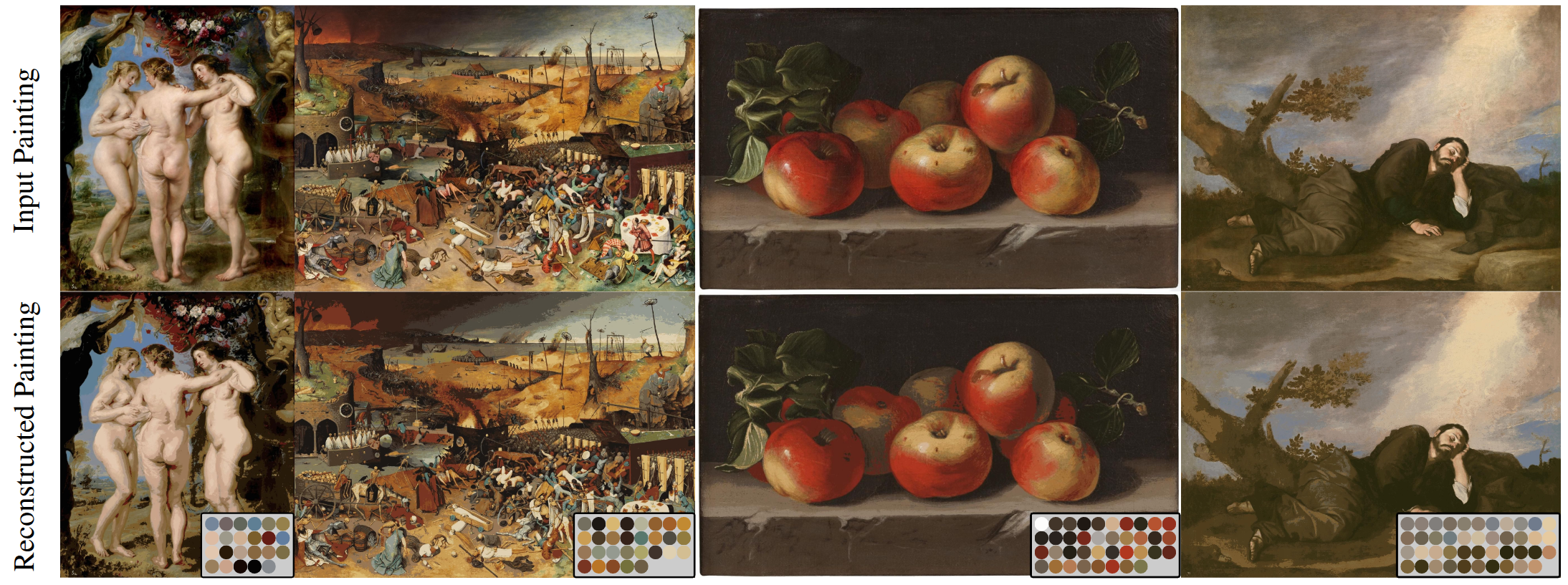
Color palette extraction is fundamental in art analysis, digital curation, and graphic design. This paper presents a fuzzy-logic-driven method for automatically deriving non-fixed color palettes from paintings. Drawing inspiration from the concept of “relevant colors” (the chromatic elements most salient to human observers), the approach employs fuzzy logic to characterize chromatic diversity using quantized color representations. This framework is particularly valuable in digital art preservation, restoration, and collection management, where accurately identifying the essential color gamut of an artwork is critical. The algorithm models perceptual color relevance by integrating luminance, chroma, and local color redundancy as input variables. A fuzzy inference system subsequently assigns relevance scores using linguistic rules, enabling adaptable palette generation tailored to each painting. Evaluated across a large dataset of artworks, the proposed method surpasses state-of-the-art techniques in image reconstruction tasks grounded in palette extraction. Furthermore, when assessed against human annotations from the Prado Museum dataset, the resulting palettes exhibit strong alignment with observer preferences and faithfully reflect the perceptual color structure of the paintings.
Downloads
Code
Bibtex
Acknowledgments
This work has been supported by grant PID2022-141539NB-I00, funded by MICIU/AEI/10.13039/501100011033 and by ERDF, EU, and by the Government of Aragon’s Departamento de Ciencia, Universidad y Sociedad del Conocimiento through the Reference Research Group "Graphics and Imaging Lab". Samuel Morillas acknowledges the support of Generalitat Valenciana under grant IMaLeVICS CIAICO-2022-051 and Spanish Agencia Estatal de Investigación under grants PID2022-140189OB-C21 and PID2023-152301OB-I00. J. Daniel Subias was supported by the CUS/702/2022 predoctoral grant. Juan Luis Nieves also ackowledges the Erasmus+ master Computational Colur and Spectral Imaging for supporting this work at the University of Granada. We would like to thank all the members of the Graphics and Imaging Laboratory who helped proofread the text