Abstract
Virtual Reality (VR) enables immersive and realistic experiences in which complex multisensory interactions can impose substantial cognitive effort on users. Excessive cognitive load (CL) has been shown to hinder performance and user experience, motivating the need for robust and non-intrusive methods for CL monitoring in immersive environments. Although prior work has explored physiological signals, many of these signals are sensitive to user movements and require complex sensor setups. Considering the widespread integration of eye tracking in modern head-mounted displays, gaze behavior positions as a promising alternative for objective CL assessment. In this work, we present an analysis of gaze behavior and its relationship to cognitive load in immersive, task-oriented environments. Using a publicly available dataset collected in a multisensory visual search experience [1], we examine how a range of low-level, gaze-derived markers (such as fixations, saccades, eye eccentricity [2], and pupil dilation) change across cognitive load conditions. We also investigate their relationship with biomarkers derived from additional physiological signals, including electrocardiogram (ECG), electrodermal activity (EDA), and respiration, to better understand how gaze-based markers relate to broader physiological responses associated with CL.
Conclusions and Future Work
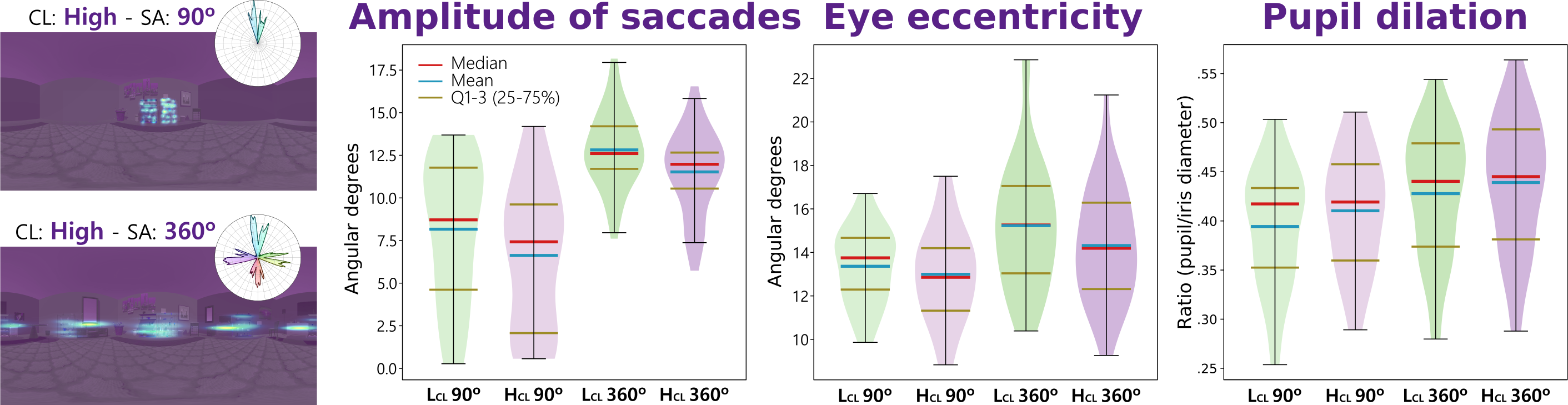
Our results reveal consistent changes in oculomotor behavior under high cognitive load, characterized by reduced saccade amplitudes and eye eccentricity, suggesting a more centered and less exploratory visual behavior, consistent with attention tunneling under high task demands [3]. We also notice an increase in pupil dilation for higher cognitive demands, which may depict increased stress levels. In addition, we identify strong correlations between several gaze markers and the phasic component of electrodermal activity, a well-known indicator of mental effort. Together, these findings highlight the potential of gaze-based measures as lightweight and non-intrusive indicators of cognitive load.
Acknowledgments
This research was funded by grant PID2022-141539NB-I00, funded by MICIU/AEI/10.13039/501100011033 and by ERDF, EU; and by the European Union (ERC grant number 101220555, PROXIE). Views and opinions expressed are however those of the author(s) only and do not necessarily reflect those of the European Union or the European Research Council Executive Agency. Neither the European Union nor the granting authority can be held responsible for them. This work has been funded by the Aragon Institute for Engineering Research (I3A) through the Impulso program. J. Pina was supported by an FPI predoctoral grant (PRE2023-UZ-16).
Material
Paper
Check out our paper here!
Slides
From the CEIG 2026 conference.
Bibtex
title = {An analysis of gaze behavior under multisensory cognitive load in immersive environments},
journal = {Computers & Graphics},
volume = {137},
pages = {104613},
year = {2026},
issn = {0097-8493},
doi = {https://doi.org/10.1016/j.cag.2026.104613},
url = {https://www.sciencedirect.com/science/article/pii/S0097849326000841},
author = {Jaime Bielsa and Jorge Pina and Ana Serrano and Daniel Martin},
keywords = {Gaze behavior, Cognitive load, Eye tracking, Visual attention},
}
References
- Pina J, Bernal-Berdun E, Martin D, Malpica S, Real C, Barquero A, Armanac-Julian P, Lazaro J, Martin-Yebra A, Masia B, Serrano A: A Comprehensive Analysis of the Influence of Cognitive Load on Physiological Signals in Virtual Reality. IEEE International Symposium on Mixed and Augmented Reality (ISMAR), 2025.
- Malpica S, Martin D, Serrano A, Gutierrez D, Masia B: Task-dependent visual behavior in immersive environments: A comparative study of free exploration, memory and visual search. IEEE Transactions on Visualization and Computer Graphics, 2023.
- Pannasch S, Velichkovsky B M: Distractor effect and saccade amplitudes: Further evidence on different modes of processing in free exploration of visual images. Visual Cognition, 2009.